
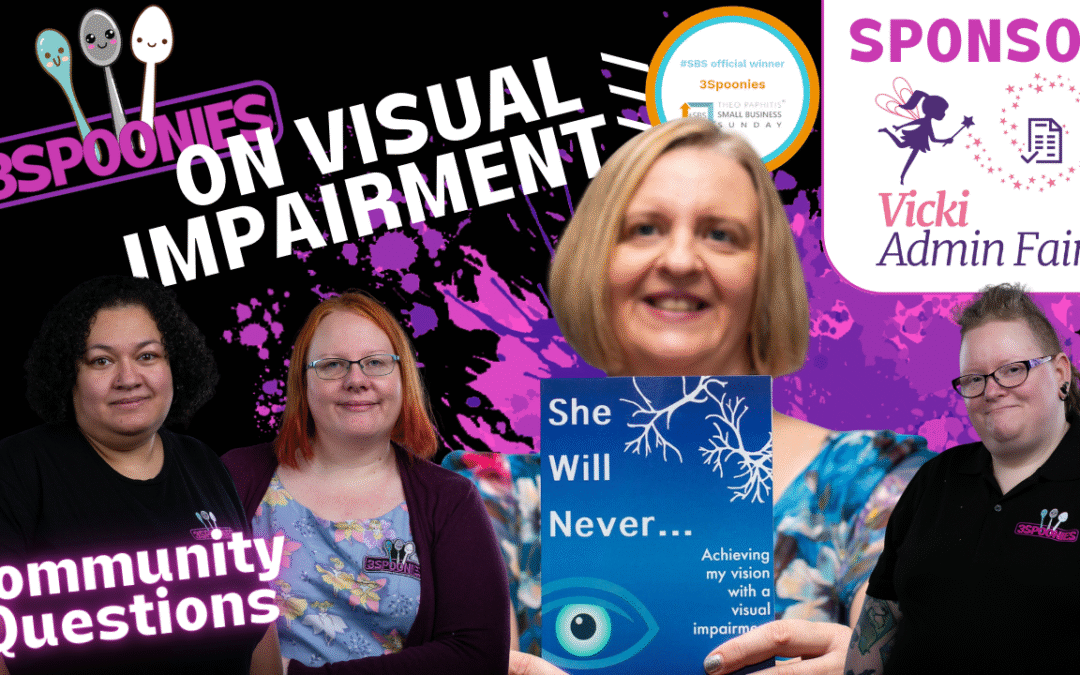
Living with a visual impairment means constantly adapting — not just in day-to-day life, but at work, in education, and even at social events. In this week’s blog, we wanted to pull together some of the most common, practical questions people ask and share insights on how to handle them with confidence, clarity, and a bit of 3Spoonies common sense.
We were joined again by Amanda Harris, a visually impaired author, speaker, will writer, and all-round superstar who lives with optic neuropathy, nystagmus and astigmatism. Amanda also supports her husband, who later lost his sight in adulthood, giving her a unique perspective on both lifelong and acquired visual impairment. Find out more about Amanda here.
Here’s what we explored together.
1. Recording Lectures & Copyright: What Are Your Rights?
Many visually impaired students rely on audio recordings or transcripts to keep up with lectures — not as a luxury, but as a reasonable adjustment.
If a lecturer refuses recording because of “copyright,” remember:
- Copyright doesn’t prevent accessibility — it simply requires the creator to be credited.
- Reasonable adjustments under UK equality law typically include recording or transcribing lectures for personal use.
- If you face resistance, your student union, disability support team, or department head can support you in challenging the decision.
As Amanda put it, expecting students to retain everything without accessible tools is unrealistic — and recording is often the most accurate and least disruptive method available.
2. When Workplaces Insist on Printed Documents Only
Some workplaces still insist on issuing policies or staff handbooks solely in print. For someone with low vision, a 200-page handbook in standard size isn’t just unhelpful — it’s unusable.
If you need accessible formats:
- Large print, digital files, or audio are all valid reasonable adjustments.
- Employers may resist because documents aren’t already digital — not because they can’t be adapted.
- Assistive tech like video magnifiers, handheld readers, or apps can help you navigate unavoidable printed material.
Amanda shared that organisations like Access to Work, My Sight Nottingham, and various regional charities can help fund equipment such as video magnifiers, screen readers, and scanning tools.
Sometimes the smoothest path is a mix of practical workarounds and a gentle reminder that accessibility is a legal right — not a favour.
3. Making Events & Celebrations Accessible for Partially Sighted Guests
If you’re hosting a wedding or party and want to make things easier for visually impaired guests, you don’t need specialist equipment — just good planning.
Helpful adjustments include:
- Brighter lighting during arrival so people can safely navigate the space.
- A greeter at the door who can help guests get oriented.
- Clear guidance on toilets, seating, and bar areas.
- Support with table plans, especially if they’re printed small or displayed in poorly lit spaces.
- Highlighting stairs or offering routes that avoid them.
These small changes help in general — not just for visually impaired guests — and create a more welcoming space for everyone.
This blog is based on our podcast episode
All of these insights came from our latest community Q&A with the brilliant Amanda Harris, where we discuss real listener questions and share tools, tips, and lived experience. Find out more about Amanda here.
If you’d like to hear the full conversation — including the humour, stories, and tangents we couldn’t fit here — you can listen to the complete episode on the 3Spoonies Podcast. Find all ways to watch and listen here.
If you’d like new episodes straight to your inbox then join our mailing list.