
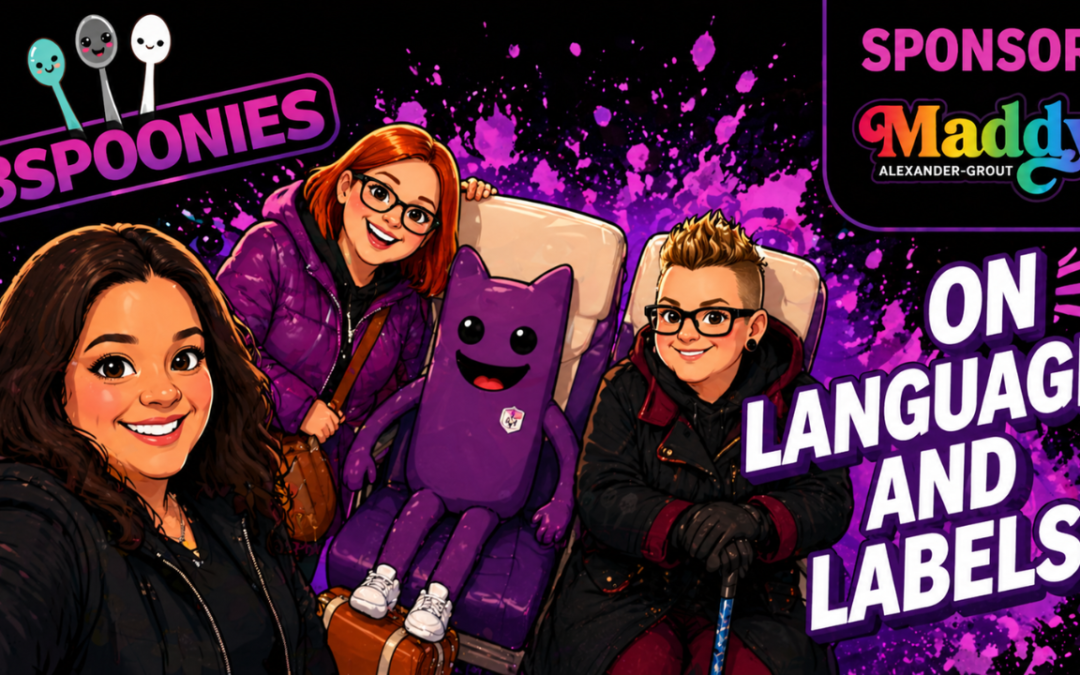
Words matter.
They shape how we describe ourselves, how we access support and how other people understand us. But they can also hurt, limit and create assumptions that are hard to shake.
In this episode of 3Spoonies, we explore the complicated relationship between language, labels, disability, neurodiversity, chronic illness and identity.
The conversation moves from personal experiences and diagnosis journeys to media narratives, community language and the labels that stay with us long after they were first used.
When Labels Help
Labels often get a bad reputation, but the episode starts by recognising that they can be useful.
Sometimes having a name for something is the first step towards understanding it.
A diagnosis, a condition name or even finding a community can help explain experiences that never quite made sense before.
Karen talks about how labels can provide language that opens doors:
- understanding yourself
- accessing support
- finding coping strategies
- connecting with others
- explaining needs to people around you
Without the right words, it can be difficult to ask for help.
Sometimes the label is not the end point.
It is the beginning.
When Labels Hurt
The episode also explores the other side.
Claire shares experiences of growing up as the only child of colour in her primary school and how labels, prejudice and assumptions shaped early experiences of racism and bullying.
Later, becoming a parent and supporting an autistic child changed how she viewed behaviour, judgment and the stories people create about others without knowing what is happening behind the scenes.
The conversation returns several times to this idea:
People often judge what they can see.
Not what they cannot.
For Jo, one of the hardest labels to accept was disabled.
Not because it was inaccurate.
But because accepting it meant grieving changes in identity, ability and expectations.
Many disabled people know that feeling.
The moment when the label becomes real is often not the diagnosis itself.
It is the point where life changes.
Gifted Children, Burnout and Missed Support
The episode also touches on educational labels.
Jo reflects on being the “gifted child” who was expected to achieve highly but whose support needs went unnoticed.
Karen shares how dyslexia was missed for years because she was seen as “bright but lazy”.
Both experiences highlight something important:
Labels influence what people look for.
But they also influence what gets missed.
When support is based on assumptions, people can fall through the gaps.
Especially girls, people from minority backgrounds and those whose experiences do not match expected stereotypes.
Identity First vs Person First Language
One of the biggest discussions in the episode centres around language itself.
Particularly:
Identity-first language
Examples:
- autistic person
- disabled person
And:
Person-first language
Examples:
- person with autism
- person with a disability
The group discusses how many disabled and neurodivergent people prefer identity-first language because it reflects lived experience rather than separating the person from part of who they are.
At the same time, the episode recognises that preferences vary.
The most important thing?
Ask people what works for them.
The people affected by the language should have a voice in shaping it.
Media, Representation and “Inspiration”
The conversation then turns to the media and the language often used around disability.
Words like:
- brave
- inspirational
- suffering
- confined to
- overcoming
- despite
all come under discussion.
The group talks about how these terms can unintentionally turn ordinary life into something extraordinary.
Disabled people existing is not automatically inspirational.
People are not here to motivate strangers simply by living.
The episode also explores how “inspiration” narratives can create pressure.
If one disabled person is celebrated for doing something, others can end up wondering:
Why can’t I do that?
Which can quickly become shame instead of encouragement.
Labels Inside Systems
Government systems, healthcare and benefits processes rely heavily on categories.
But people rarely fit neatly into boxes.
The discussion highlights frustrations around forms, assessments and “primary conditions” when many people live with multiple diagnoses that overlap and interact.
A label may describe one part of someone.
It rarely describes the whole person.
Claire talks about how difficult it can feel writing benefit forms for loved ones because putting everything into words forces you to see challenges laid out in black and white.
That process can feel surprisingly emotional.
Community and Finding People Who Understand
Despite the difficulties, labels can also create belonging.
The episode explores how disability, neurodivergent and spoonie communities allow people to skip past explanations.
Sometimes you do not need to explain fatigue.
Or brain fog.
Or sensory overwhelm.
People simply know.
That shared understanding can be powerful.
It creates space.
It reduces isolation.
And sometimes it helps people realise they are not alone.
Final Thoughts
Language is never neutral.
It carries history, identity, assumptions and emotion.
Labels can empower.
They can hurt.
They can explain.
And sometimes they can do all three at once.
The important thing is listening.
Listening to how people describe themselves.
Listening when communities say language has changed.
And remembering that behind every label is still a whole person.
Listen to the Episode
Search for “3Spoonies Episode 60 – Language and Labels” on YouTube or your favourite podcast platform. Or click here.
About 3Spoonies
3Spoonies is a podcast exploring disability, chronic illness, neurodivergence, business and everyday life — honest conversations from people navigating life with not enough spoons.