
Sometimes conspiracy theories are dangerous.
Sometimes they’re harmful.
And sometimes they’re so wonderfully ridiculous that all you can do is sit back, laugh and wonder how anyone came up with them in the first place.
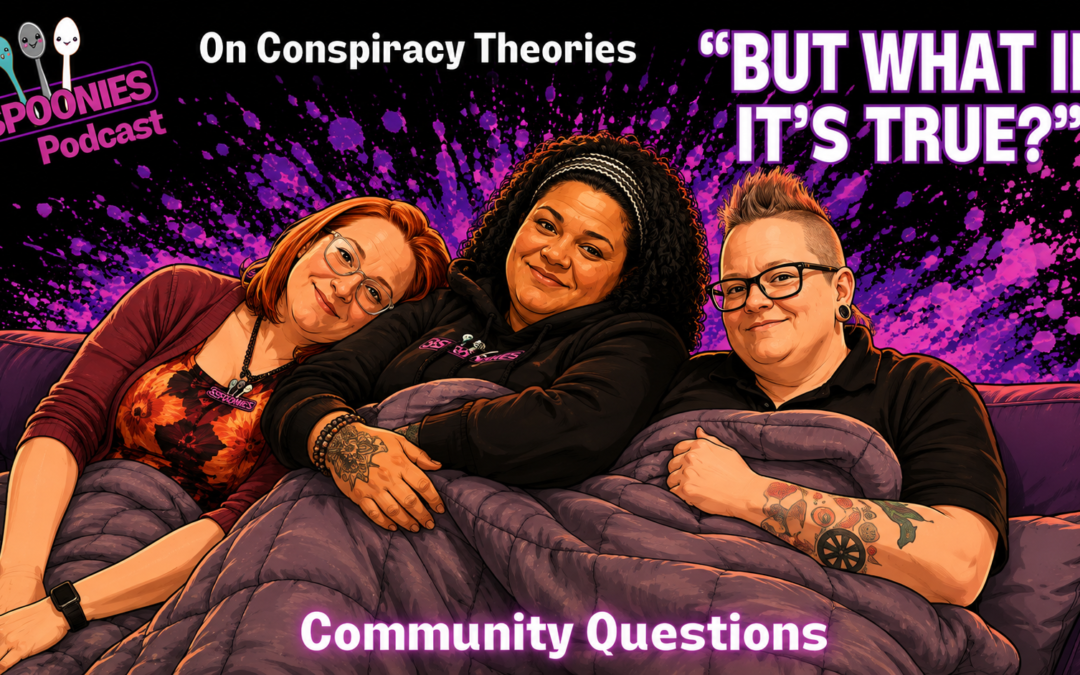
In this bonus Halloween episode of 3Spoonies, we took a break from the more serious side of conspiracy theories and explored some of the strangest, funniest and most entertaining examples we could find.
From secret celebrity replacements and shadowy organisations to government surveillance pigeons, we went down several rabbit holes that left us questioning absolutely nothing except humanity’s imagination.
Did Paul McCartney Die In 1966?
Claire kicked things off with one of the most famous celebrity conspiracy theories of all time: the claim that Paul McCartney died in a car crash in 1966 and was secretly replaced by a lookalike.
According to believers, the evidence is everywhere.
The Beatles supposedly left clues hidden in album artwork, song lyrics and photographs.
Among the “proof” often cited are:
- Paul walking barefoot across the Abbey Road crossing
- Hidden messages in album covers
- References to death throughout Beatles songs
- Backwards recordings revealing secret messages
- The mysterious appearance of “Billy Shears”
Like many conspiracy theories, the more you investigate, the more elaborate it becomes.
The challenge, of course, is explaining how one of the most famous bands in history managed to hide something so enormous while continuing to perform, tour, record and interact with millions of fans.
Still, it’s a fascinating example of how people can find patterns and meanings in almost anything once they start looking for them.
Did The Illuminati Destroy Right Said Fred?
Karen took us on a surprisingly detailed investigation into another unusual claim: that the Illuminati approached Right Said Fred, they refused to join, and their career was subsequently destroyed.
Rather than accepting the theory at face value, Karen did what every good conspiracy investigator should do.
She checked the evidence.
Armed with chart records, release dates and a healthy dose of scepticism, she traced the band’s success throughout the 1990s and beyond.
The results raised some awkward questions for the theory.
If the Illuminati were determined to silence Right Said Fred:
- Why were they still having chart success?
- Why were they involved in Comic Relief?
- Why were their songs appearing in major television shows and films?
- Why were they still releasing albums and performing internationally?
Sometimes the simplest explanation is also the most likely.
Bands rise.
Bands fall.
Musical tastes change.
Not every career slowdown requires a secret society pulling strings behind the scenes.
Birds Aren’t Real
Jo’s contribution may have been the most ridiculous conspiracy theory of the lot.
Or perhaps the most brilliant.
Birds Aren’t Real is a satirical movement that claims birds were secretly exterminated and replaced with government surveillance drones.
According to the theory:
- Birds sit on power lines to recharge.
- Bird droppings are actually tracking technology.
- Pigeons are urban surveillance units.
- Seagulls are advanced monitoring devices.
- Bird watching goes both ways.
The movement was deliberately created as satire, designed to parody the increasingly bizarre nature of online conspiracy culture.
Yet one of the most interesting things about Birds Aren’t Real is how many people encounter it without realising it’s a joke.
It demonstrates just how easily absurd claims can spread online when they’re repeated often enough.
Why Do We Love Conspiracy Theories?
Although this episode was much lighter than our main conspiracy theories discussion, it still highlighted an interesting question:
Why are people so fascinated by these stories?
Part of the appeal comes from mystery.
People enjoy solving puzzles.
We like feeling as though we’ve discovered hidden information that others have missed.
Conspiracy theories often provide neat explanations for complicated events.
They offer certainty in situations where reality is messy and unpredictable.
Sometimes they’re entertaining.
Sometimes they’re unsettling.
And sometimes they’re simply impossible to resist reading about.
The Importance Of Keeping A Sense Of Humour
One of the joys of this bonus episode was being able to explore conspiracy culture without getting bogged down in misinformation or fear.
While some conspiracy theories can have serious consequences, others are simply examples of human creativity running completely out of control.
Whether it’s hidden Beatles messages, celebrity replacement theories, secret societies controlling pop music or government spy pigeons, these stories remind us that people are incredibly good at finding connections between things—even when those connections don’t actually exist.
Final Thoughts
Conspiracy theories can tell us a lot about the world.
Sometimes they reveal genuine mistrust.
Sometimes they expose unanswered questions.
And sometimes they remind us not to take everything quite so seriously.
If nothing else, this episode leaves us with one important lesson:
Always question what you’re told.
Always check your sources.
And if a pigeon seems to be watching you for a little too long…
Well.
Maybe keep an eye on it.
Just in case.
Click here to find the main ways to watch and listen to the full episode.