
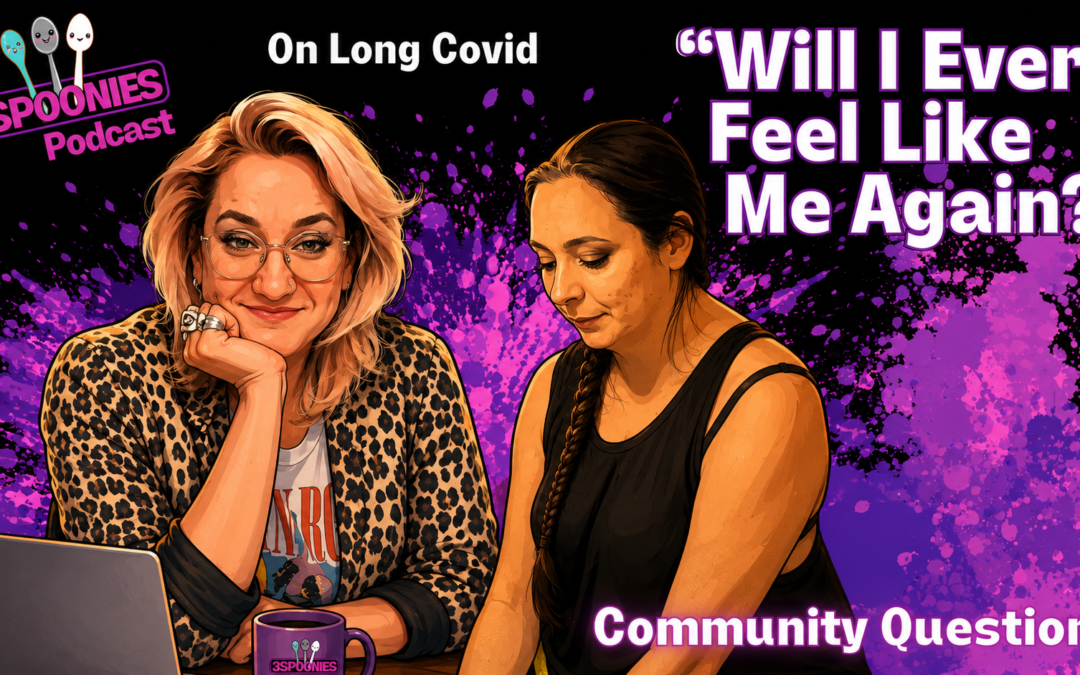
Living with Long COVID comes with a lot of questions.
Unfortunately, quite a few of those questions still have the incredibly frustrating answer:
We don’t know.
In our main episode on Long COVID, we spoke with Amy Butterworth, also known as LongCovidRockstar, and Emma Brackenbury about their experiences of developing Long COVID and how it has affected their health, work, identity and everyday lives. You can find out more about them here.
For our Community Questions episode, Amy and Emma joined us again to tackle questions submitted by the 3Spoonies community.
We talked about the relationship between Long COVID and ME/CFS, trying to avoid infections, what happens when you catch COVID again, and why describing chronic fatigue with a simple number doesn’t necessarily tell anyone very much.
And, naturally, we somehow ended up inventing a fatigue scale involving soup.
Is Long COVID a Type of ME/CFS?
Our first question was deceptively simple:
Is Long COVID a special kind of ME, or is it something separate?
The answer?
We don’t really know.
There are similarities between Long COVID, ME/CFS and other chronic and post-viral illnesses, but there are also differences. Individual experiences vary enormously too.
Emma described the way she personally thinks about it as a large post-viral illness umbrella.
Rather than necessarily thinking of ME/CFS and Long COVID as exactly the same condition, she sees them as different strands that may sit underneath that larger umbrella: a virus has affected the body, and that impact has continued long after the original infection.
Importantly, Emma was very clear that this was simply the way she conceptualises her experience rather than a medical explanation.
There is still a huge amount we don’t understand about these illnesses.
Long COVID Was Named by Patients
One particularly interesting part of the conversation was discovering where the name Long COVID came from.
Amy explained that it was a patient-created term.
People who had contracted COVID but weren’t recovering began finding one another online and sharing their experiences.
COVID wasn’t going away.
Their symptoms were continuing.
It was, quite literally, long COVID.
It’s a fascinating example of patients identifying and giving language to their own experiences while understanding of the condition was still developing.
Can You Avoid Getting Ill Again?
Another community member asked what they could do when every new illness seemed to make their Long COVID worse.
The immediate answer was slightly less helpful:
You can’t completely avoid germs.
Even staying at home doesn’t guarantee you’ll never encounter them because other people can bring illnesses into your environment.
That doesn’t mean there aren’t choices people can make based on their own circumstances, though.
Amy explained that she still masks on public transport and in crowded places such as theatres, cinemas, gigs and events. For her, masking is also an act of solidarity with other people who may be immunocompromised.
Karen also shared her experience of catching COVID again over Christmas two years running and becoming considerably worse afterwards.
That won’t necessarily happen to everybody, but it has made her more conscious of how much she’s doing and how closely activities are scheduled together.
The aim isn’t necessarily to never leave the house.
It’s about considering risk, listening to your body and giving yourself opportunities to recover between activities.
How Do You Describe Chronic Fatigue?
Then we reached perhaps the most important question of the episode:
How do you actually describe fatigue?
Because “I’m tired” doesn’t really cover it.
Jo described limbs feeling as though they’re made of concrete.
Amy suggested concrete, treacle or noodles.
Karen gets noodle arms.
And suddenly we’d moved considerably beyond the traditional one-to-ten scale.
But underneath the humour was a genuinely useful idea.
Amy talked about using descriptive words rather than judgement words.
Instead of:
“I feel bad today.”
You might say:
“I feel heavy today.”
That might seem like a tiny distinction, but emotionally it can make a considerable difference.
One describes what your body is experiencing.
The other can begin to sound like a judgement about how well you’re coping.
When you’re potentially dealing with a fluctuating condition for a very long time, constantly categorising yourself as having a “good” or “bad” day can start to affect how you view yourself.
Your body is doing something today.
You can describe it without judging yourself for it.
Is a Fatigue Scale Actually Useful?
That led us into another question.
Does putting a number on fatigue actually work?
A six out of ten today might feel completely different from a six out of ten tomorrow.
Your mood can change how you experience symptoms.
Your circumstances can change.
And even if your personal scale were completely consistent, somebody else’s interpretation of that number might be completely different.
Karen gave the example of someone saying they’d had a fantastic day because they’d managed to walk to the end of the garden.
For that person, that achievement could represent a nine out of ten day.
To somebody without their health limitations, walking to the end of the garden might barely register as an activity.
The numbers don’t communicate the context.
And context matters enormously when you’re talking about chronic illness.
Some Days You Just Feel Like Soup
Which naturally brought us to perhaps the greatest contribution 3Spoonies has ever made to chronic illness research:
The Soup Scale.
Amy pointed out that some days she simply feels like soup.
Where exactly does soup belong on a conventional fatigue scale?
We don’t know.
Emma suggested stew and dumplings at one end and cucumber soup at the other.
Karen wondered whether colours might work instead.
And while we probably won’t be submitting the Soup Scale for medical peer review any time soon, there’s actually something valuable underneath the silliness.
Finding your own language can make describing fluctuating health easier.
Maybe you’re concrete today.
Maybe you’re noodles.
Maybe you’re Guns N’ Roses.
Maybe you’re completely Sigur Rós.
Maybe you’re soup.
The important thing is finding language that communicates something meaningful to you, rather than forcing an incredibly complicated experience into a number that doesn’t really fit.
Disability Leave Shouldn’t Come Out of Your Holiday
Towards the end of the episode, Amy also talked about her campaign with Organized Network to make disability leave a statutory workplace provision in the UK.
The principle is straightforward.
Disabled employees may need time away from work specifically to manage an ongoing condition.
That isn’t the same as taking a holiday.
And it isn’t necessarily the same as becoming temporarily ill and needing ordinary sick leave.
Amy argues that disabled workers should have specific disability leave available so they aren’t forced to use their holiday entitlement or other leave simply to manage their condition.
Creating Accessible Spaces Means Letting People Say What They Need
The episode ended with an unexpectedly perfect example of accessibility in practice.
During the recording, Amy had moved from sitting at her table to the sofa as her energy decreased.
She’d also told us that she had a limit and needed us to keep things moving.
At the end, she thanked us for making the recording feel like a space where she could comfortably say that.
And that’s really important.
Accessibility isn’t only about anticipating every possible requirement before somebody arrives.
It’s also about creating an environment where someone feels safe enough to say:
I need to move.
I need a break.
I can’t do this for much longer.
I need something to change.
When one person feels able to voice that need, it can also give everyone else permission to acknowledge their own limits rather than silently pushing through them.
Final Thoughts
There still aren’t simple answers to many questions about Long COVID.
We don’t fully understand its relationship with ME/CFS and other post-viral illnesses.
There isn’t a foolproof way to avoid every infection.
And there certainly isn’t a universally useful way of measuring something as complex and changeable as chronic fatigue.
But perhaps we don’t need to have all the answers before we start listening to the people experiencing it.
We can make adjustments.
We can give people space to recover.
We can listen when somebody tells us they’ve reached their limit.
And we can find better ways to talk about fluctuating health without turning every difficult day into a judgement about ourselves.
Because sometimes you’re productive.
Sometimes you’re exhausted.
And sometimes you’re soup.
Listen or watch 3Spoonies: On Long COVID – Community Questions here
Find out more about our guests Amy and Emma here.
We’d love to know: How do you describe your fatigue? Do numbers work for you, or do you have your own version of the Soup Scale?