
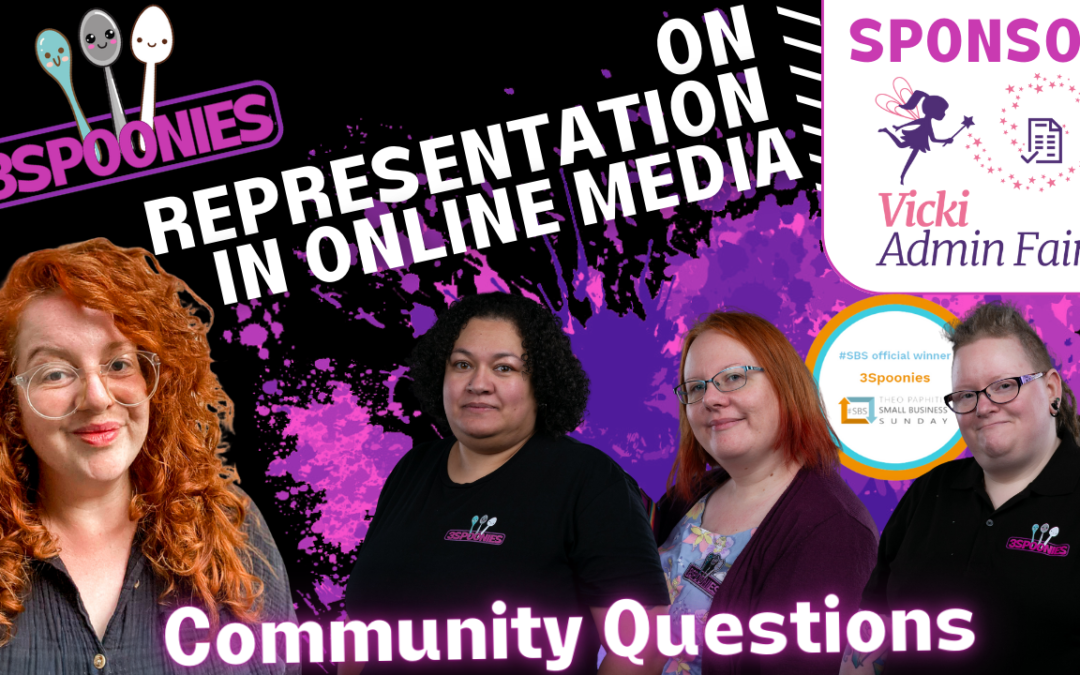
Representation matters. We say it a lot, we hear it a lot – but when you’re disabled, chronically ill, or neurodivergent, it’s not just a nice idea. It’s the difference between feeling seen and feeling erased.
In this community questions episode, we’re joined again by Dr. Zara Bain, you can find more info about her here. We talked openly about disabled representation in online media – social media, advertising, influencers, content creators, and everything in between. And honestly? There’s still a lot to unpack.
Because while visibility has improved in some areas, many of us still feel misrepresented, stereotyped, tokenised, or completely left out of the picture.
So let’s talk about it.
Being Seen… or Being Stereotyped
One of the biggest themes that came up was this:
being visible doesn’t always mean being represented well.
Disabled people in media are often shown in very narrow ways:
- The “inspirational” overcomer
- The tragic figure
- The brave warrior
- The one who’s “so positive despite everything”
And while those stories exist, they are not the whole story.
Most of us are just… people. Living life. Running businesses. Parenting. Working. Resting. Existing. And when the only versions of disability we see online are extreme, emotional, or performative, it creates a skewed picture of what disability actually looks like.
Representation shouldn’t have to be dramatic to be valid.
Invisible Disabilities & Being Overlooked
We also talked about the huge gap between visible and invisible disabilities.
If you don’t “look disabled”, you’re often:
- Not believed
- Not included
- Not considered in design, content, or campaigns
- Expected to just “cope”
Online, this plays out in subtle but exhausting ways. Content that assumes everyone is healthy. Campaigns that forget chronic illness exists. Accessibility that only considers wheelchairs and nothing else.
If you live with fatigue, pain, brain fog, sensory issues, autoimmune conditions, or fluctuating capacity, you often end up feeling like you don’t fit anywhere – not in able-bodied spaces, and not always in disabled spaces either.
And that can be incredibly isolating.
The Pressure to Perform Disability Online
Another big topic was the pressure to perform disability in order to be taken seriously.
To explain.
Many disabled creators feel they have to:
- Share medical details to be believed
- Prove how bad things are
- Be educational all the time
- Or be “palatable” and inspiring
That’s a lot to carry.
No one should have to trauma-dump, educate, or justify their existence just to be respected online. And yet, disabled people are constantly expected to explain, soften, or package their experiences in ways that make others comfortable.
Representation should not come at the cost of emotional labour.
Tokenism Isn’t Inclusion
We also touched on tokenism – when brands, businesses, or platforms include a disabled person just to tick a box.
One wheelchair user in a campaign.
One disabled face in a stock image.
One awareness post a year.
That’s not inclusion. That’s optics.
Real representation means:
- Disabled people involved in planning, not just visuals
- Accessibility built in, not bolted on
- Lived experience valued, not mined
And yes, sometimes it means getting it wrong, listening, and doing better. That’s okay. What’s not okay is ignoring disabled voices altogether.
Why Authentic Voices Matter
If there’s one thing we kept coming back to, it’s this:
Nothing about us without us.
Disabled people are the experts in their own lives.
Not charities. Not brands. Not well-meaning allies.
When disabled voices lead the conversation, representation becomes:
- More nuanced
- More realistic
- Less stereotyped
- And far more powerful
Because disability isn’t one experience. It’s many. And no single person can represent everyone – which is exactly why we need more voices, not fewer.
What Can Be Done Better?
We don’t believe in just pointing out problems without offering solutions. So here’s what we’d love to see more of:
- Disabled people in everyday content, not just “disability content”
- Brands asking, not assuming
- More behind-the-scenes inclusion, not just front-facing diversity
- Better accessibility in websites, videos, captions, and design
- Space for disabled creators to be messy, funny, boring, complex – like everyone else
Representation isn’t about perfection. It’s about effort, respect, and willingness to learn.
You’re Not Overreacting
If you’ve ever felt:
- “Why is no one like me in this space?”
- “Why do they always show us like that?”
- “Why does this make me feel uncomfortable but I can’t explain why?”
You’re not overreacting. You’re noticing patterns.
And those patterns shape how people treat us in real life.
That’s why representation matters. Not because it’s trendy. But because it affects how safe, valued, and understood we feel in the world.
Want to Hear the Full Conversation?
This blog is just a snapshot of what we covered in the episode. We go much deeper into the emotional side, the lived experience, and the community questions that sparked some really honest conversations. Remember you can find out more about our guest, Dr Zara Bain here.
You can listen to the full episode of 3Spoonies here, or wherever you get your podcasts or watch on YouTube.
As always, we’re navigating life and business with not enough spoons – and we’re really glad you’re here with us.
If you’d like each new episode to your inbox then join our mailing list.